Monday, January 30, 2012

Neuro: punked

So I've been punked. My very first day. By the ER residents. I was just minding my business doing rounds when they asked me for help. Ironically, it was thanks to my MRI skillz that got me into trouble.

The ER residents know me now, I think they all might talk about how annoying it is that I hang around so much, but you know. At least they know me. Anyhow, they asked me to come over and read this MRI with them.   They point out this is a female patient with pain. They point to the bottom of the screen and say this is the tibia (pure white triangle upside down) and the thing above it (circle) is the knee cap (big white circle)... what is wrong with the knee surface? And there are some grey swirls in the top circle.  I start trying to guess, cartiledge changes? Fracture? No way its a fracture, what they heck is that? Foreign body? Is that a quarter in the knee?

At this point they are peeing their pants laughing (like i'm pretty sure i saw some darkening of the pants) and I am just ignorantly guessing thinking, Man i am like the worlds worst MRI-reader.  And finally they say, that's a baby.  That's totally not the knee. And I am looking all sheepish and all oh, i totally knew that. (ha. good cover, right).

Now, I'm sure you're thinking I'm going to be the world's worst doctor. But these images are remarkably similiar if you get just 1 picture.  To demonstrate how ridiculously similiar these images are I went to google. However, my image was a lot less obvious. You have to use your imagination, and a lot less arrow signs.  Again, these images (unlike the rest of them on my blog) are from GOOGLE. Not actually my images.


So turns out prego women get MRI's all the time for appendicitis. And no problems with the baby.  However, I guess this 'baby in the knee' on MRI is a big funny joke they do to all the new interns. So I guess they felt like I needed to be broken in.... maybe i'm making an impression after all?

Saturday, January 28, 2012

Gen Surg: Final Thoughts

So Surgery is over. And I don't have anything new to say that I haven't already said. In the end, I liked it. The surgery part was interesting. I imagine doing it everyday would be rewarding.  However, the lifestyle is too much for me. The bottom line is at the end of the day I am NOT willing to give up all of my chances at a personal life....or a family. I just don't love it enough. I don't think I love anything that much.... Plus, I learned from this rotation that I value sleep too much.  And that there are many jobs that are beyond me and this is one of them.

The dedication you surgeons have to your profession is unbelievable. Yet, I must say I'm a bit relieved its over. Now on to Neurology.

Monday, January 23, 2012

Gen Surg: Radiology lessons

So check it out- radiology at my school was somewhat... subpar. So I have been saving certain characteristic or obvious CTs and xrays to help me learn. And trust me, when you're scrolling through half a dozen CTs, MRIs, and xrays full of shades of grey every couple hours these aren't so easy to pick out. So here are a few of the images and there answers (i've kindly added the 'arrow sign') below (don't cheat!) So here is a radiology lesson of the past monthish of patients, see if you can find the defect.


Here is a general xrays of a patient who had a collapsed lung (pneumothorax). You might be familiar with this condition because TV shows glamorize this condition (when the doc stabs someone in the chest with a needle and suddenly they can breath again). For the most part, the TV treatment is true but generally something has to HAPPEN to your lung for it to collapse (aka car accident, lung CA or disease, emphysema, etc), it doesn't just happen in the middle of a restaurant...usually. And unlike they show on TV if its less than 10% of the lung (as both of these are) and if the patient is not symptomatic, we don't  stab anyone with anything. You body will reabsorb it on its own without any problems. (i know.... so much less fantastic than TV).


Crash Course for beginners: a CT scan (also known as a CAT scan) is probably one of the most useful scans done in the hospital. It is a 2d picture of your insides, showing your docs what's going on inside. Typically, they are loaded on a computer for doctors to scroll through some 200 images are taken every millimeter of your body. It starts at your feet and works it way up to your head. They are done at different angles depending on what the doctor wants, but ususally they are done with the patient laying down.

This patient is a person who was in a MVC (motor vehicle collision) we also call it car vs. pole.  He had some abdominal pain and a quickly dropping H&H (hemoglobin and hematocrit). We got the CT and immediately called the trauma team. You can see how the blood is pooling by the liver (the liver bleeds fast!)


This is an elderly (88yo) woman who was incontinent and who often had UTIs. Everyone just assumed she was old. Then due to an incidental finding by an ER doc and a bunch of workups later we found this. A hole between two different organs is called a fistula Poor Poor woman.  She has a hole between her anus and vagina and then vagina and bladder.  So if you can imagine... she has poo coming out not only her vagina but also poo in her bladder.


Here is an easy picture that hopefully anybody can see. Blood in the lungs, we call it hemothorax.


It is very important to look at the CT a couple of times because oftentimes you find other things you wouldn't have normally seen. Below are some images of the above patients who had some very cool incidental findings. The first one is calcifications of the aorta.


Well hopefully that was enlightening :) Fun pictures definitely. Interesting if nothing else. Til next time.


Thursday, January 19, 2012

Gen Surg: 'official'

So i was told I am now an official medical worker.

There was a 40 y.o. M who had a bowel exploratory surgery. He was in good shape and quite the organic food lover. I had checked up on him every morning for about 4 days so we had some report. His diagnosis was Crohns. Anyway, He had a huge line of staples maybe about 50 because his incision went from sternum edge (xyphoid process) down to the pubic bone. Anyhow, they wanted me to remove them so he could go home and I wanted to do a good job. The attending left and I went very slow to make sure they didn't hurt him (no pain meds). So as I take them out one by one, I ended up sitting on the bed and leaning over to intently pull out these staples. And about oh 4 staples to go at the bottom, I realize.... there is this hard object poking my elbow..... in his pants.... wait a minute! It was all suddenly awkward and i pulled the last staples out really quick. Then I  basically bolted out of the room. (talk about not handling that situation with grace....) So yeah. Gave my first boner to a patient. Not awkward at all, especially because the nurse saw the whole thing. And she just laughed at me, no warning nothing, just laughed silently in the corner!!

All the MALE surgery residents heard about it and thought it was the funniest thing ever. Obviously, I never heard the end of it.... *Sigh*  at least I know to pay more attention to the patient and less to the staples....

Tuesday, January 17, 2012

gen surg: textbook case

Here is another couple of cases. This 58y.o. male presented with some rectal bleeding and constipation. He had no fever, no white blood count but some 10 pound weight drop in the last couple weeks. Below is the actual imaging results. There is barium enema and it shows as I added to the xray below-- what we call an apple core lesion. You can see how the barium (white color)  narrows in part of the colon- it narrows to the size of an apple core because there is a tumor that is blocking most of the lumen.  This is usually a sure fire sign of colon cancer. It was strange to see this on the computer because its basically right out of our text books. You should also notice in the right upper part of the picture the obvious loops of bowel that are full of air. This is called "ladder rungs" and it indicated an intestinal tract obstruction (probably caused because the poo can't pass the cancer. We took him to surgery the next day, took out the part that was full of tumor and he is doing well, cancer free.


Monday, January 16, 2012

Gen Surg: Quickie Update

Okay so I have a few pics that I gotta post else I'll forget. But thus far, surgery really picked up this last week. All the residents took their in-service exams (specialty specific) and now they mean business. So if it was even possible,  I am even busier than I was before. Now I'm following them to different hospitals, answering consults on my own, and even witnessing political pissing contests between surgeons. I spent a 'short' day on saturday that was as the resident proclaimed it gunna be 'quick and easy.'  And of course I was there for 14 HOURS!! Without lunch. I had a fig newton as dinner. And about 4 cups of coffee. More later.


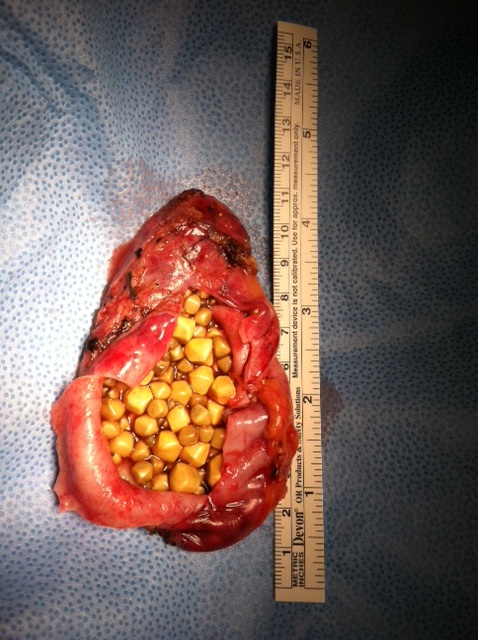
So about oh 40% of general surgery cases have to do with the gallbladder. There is at least one every other day. SO i might as well document a couple. Usually you get your gallbladder out because you have gall stones or an infection. In the surgery world, most gallbladder removals (cholecystectomy) are done laparoscopically. Thus we call them a 'lap chole' (lap kohl-ie).  WE put in four tiny inch wide incision in the belly then blow up the belly with CO2 gas. Put in something called a port where we can hold open the hole for our long instruments and peel the gallbladder off the liver. Because this surgery is so common, most surgeons keep a log of how long it takes them on average to do a lape chole. This number is what they compare to others to find out if their skills are good, bad or average. Weird I know.  But they don't really have their eye on the clock, at least none of the surgeons i've seen do. The nurses keep track for them. Below is a picture I took of one of my patient's gall bladder's filled with stones, these stones are made of cholesterol. (don't eat at McDonald's kids).

Next case is probably best patient of the year. Guy comes in to ER, who has a PEG tube. Its a little hole in your abdomen that has a tube in it so we can feed you without putting food in your mouth. This is usually done for someone who is having trouble swallowing or who is in a coma and can't be eating.  This PEG was in a guy who had suffered a anoxic brain injury from a car crash. He was mentally not with it and he pulled out his PEG tube and ATE IT.  Yeah that's right. He ate his own PEG tube. :D   We crazy docs thought this was just hilariously ironic. We gave him another one and admitted him to the hospital where he pooped it out without a problem. Weird thing is he can totally understand you and follow commands, he just has to be restrained. It should also be mentioned that he ate chunks out of the blanket in the ER, grinds his teeth together (its painful you can tell because of the sound) and constantly licked his arms. This is where several med students and I came up with the phrase "you can lick your arm if you wanna."  which is applicable to any patient who does something stupid but they do it anyway. I think its catching on...   Below is a picture of his PEG tube. Nothing special. 


Thursday, January 12, 2012

Gen Surg: Bowel Perf - EDIT

Hey, I added this late. I realize. But hey surgery schedule is crazy.  Anyhow remember that gen surg is all about bowel. And there are lots of bowel surgeries. Why wouldn't there be being that your abdomen is full of it. If you want to know what it feels like imagine a rope of warm Jello and it is the thickness of your eyelid.  Go ahead a just try to hold it... good luck.  And you can totally feel the poo move through it, though the bowel doesn't like to be touched so it generally stops moving the poo when you touch it. Medically, whenever the bowel is touched there is a huge possibility of something called 'adhesions.'  Adhesions are tiny threads of tissue that are kinda like scar tissue that are very strong and can cause bowel obstruction and chronic pain. Adhesions are the #1 most common side effect of any abdominal surgery.

 You should also know that there are tiny 'tags' of fat that hang off the bowel. This is true for everyone, but the more fat that a person stores the more 'tags' there are on the bowel. These tags are the most variable area-- and function for a little bit of protection for those easy to rip bowels.

Lastly, the bowel is divided into different parts. Small intestine: duodenum, jejunem, and Ileum.  Large intestine: colon, sigmoid, rectum. The small intestine does most of the absorption. The large intestine absorbs mostly water. There is lots of bacteria in your bowel, but the most importantest are in the colon because they can make vitamins like B12 and they make gas when they breakdown (cough cough farts).

Anyhow, these pictures are of a bowel perforation, but not via trauma or other surgeons. It was from straining too hard when he POOPED. Yeah, bet you'll never think about pooping the same way. haha. ah, the terrors of life. :)  Anyhow, Bowel perforation is a big deal for a bunch of reasons. 
  •  The first is it is leaking all of the digestive materials into your abdomen = gross.  Bowel perforations when you open the belly don't just smell like ordinary poo (ordinary poo goes through the colon which dries it out and all the nutrients are already gone). It smells unlike anything you've ever smelt before. And its awful.   
  • Next, all the bacteria in our food plus the bacteria that helps us digest our food leaks into the bowel. Causing fever, infection, sometimes abscesses, or other major problems. 
  • Lastly it won't heal itself. So it can be life-threatening. 
So...  this hole is in the colon. You can see in the picture to the right, i put the tools pointing at the hole.  You can also see the appendix dangling off the left part. The green above the hole means that the bowel contents (the poop) has already been in the abdomen long enough to stain the outside of the bowel. 

Why is it green?  Green is the color of bile. Bile is made in the liver and stored in the gall bladder. Bile helps us digest fats. As the poo material goes through the bowel different enzymes are added until eventually it breaksdown or gets reabsorbed to become brown. Ta duh! Lesson of the day.

Check out this close up of the perforation....